
China Top Boat Trailer Manufacturers How to Choose?
Choosing among China’s top boat trailer manufacturers requires more than comparing catalog prices. A reliable boat trailer must match your boat’s hull shape, length, weight, axle capacity, and launching conditions. During inspections, experienced buyers check weld consistency, roller alignment, bunk support, winch quality, lighting protection, and corrosion resistance. A trailer may look polished in photographs yet perform poorly beside a saltwater ramp. Small details matter.
Manufacturing experience is equally important. Established suppliers should provide clear material specifications, load calculations, production photos, inspection records, and practical warranty terms. Ask whether the frame uses hot-dip galvanized steel, aluminum, or another suitable material. Each option has different maintenance demands. Request evidence of salt-spray testing when coastal use is expected. Do not rely only on attractive claims.
Communication also reveals professionalism. A capable manufacturer will confirm measurements instead of guessing. They should discuss spare parts, delivery protection, braking systems, and local towing requirements. Certifications can support credibility, but documents should be current and verifiable. A low quotation may hide weak components, limited support, or costly modifications later. That risk deserves attention.
Real buying decisions are rarely perfect. Even a trusted supplier may misunderstand a custom hull or underestimate regional road conditions. Send detailed drawings, photographs, and measured data. Clarify every assumption in writing. Compare several manufacturers through samples, factory audits, customer references, and after-sales responses. The best choice is not always the cheapest trailer. It is the supplier that consistently delivers safe design, stable quality, transparent communication, and dependable support after the boat trailer reaches the water.
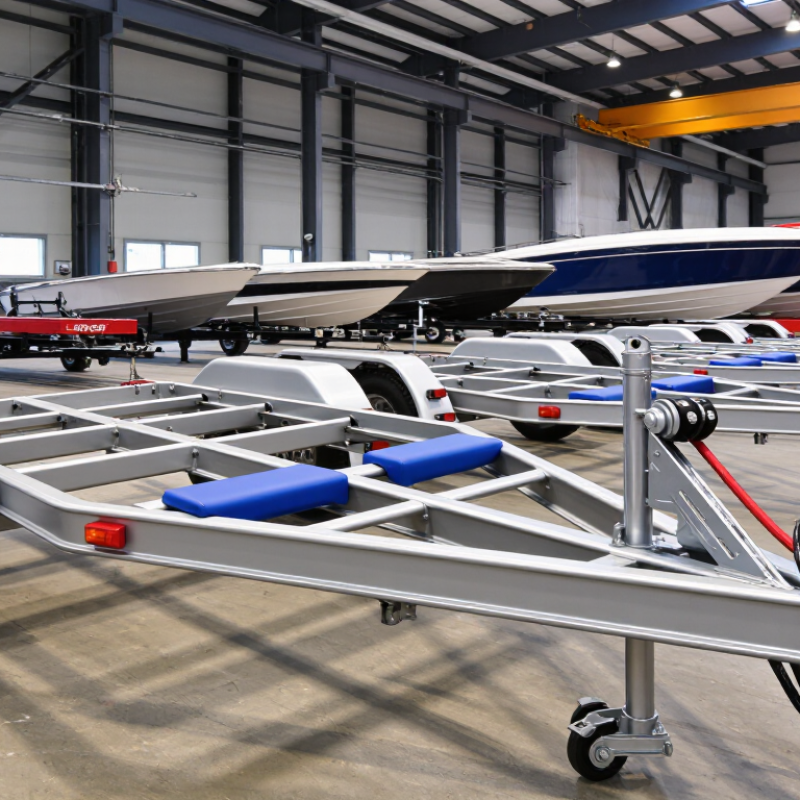
Boat Trailer Types and Their Main Applications
China Top Boat Trailer Manufacturers: How to Choose?
Boat trailers differ because boats differ. A bunk trailer supports the hull with long carpeted beams. It suits fishing boats, runabouts, and vessels with strong, defined keels. Roller trailers use multiple rollers, making launching easier on shallow or uneven ramps. However, poor roller adjustment can press against delicate hull areas.
Pontoon trailers use extended frames and support the boat beneath its deck structure. They are practical for wide, flat-bottomed pontoons. Personal watercraft trailers are lighter, shorter, and easier to store in narrow spaces. Flat-deck trailers can carry workboats or unusual hulls, but they require careful tie-down planning. In saltwater areas, galvanized steel or aluminum can reduce corrosion concerns, though neither material is maintenance-free. Check the load rating, axle capacity, brake system, winch position, and lighting before choosing a manufacturer.
Tips: Match the trailer to the boat’s actual loaded weight, not its showroom weight. Measure the hull width and keel height. Inspect welds, rollers, bunks, tires, and coupling hardware before purchase. A trailer may look strong but still distribute weight poorly. That mistake is easy to miss. Leave enough capacity for fuel, batteries, safety equipment, and personal gear. Recheck the setup after several launches; the first adjustment is rarely perfect.
China Top Boat Trailer Manufacturers How to Choose? - Boat Trailer Types and Their Main Applications
| Boat Trailer Type | Typical Boat Length | Typical Load Range | Main Applications | Recommended Frame and Support | Key Selection Considerations |
|---|---|---|---|---|---|
| Single-Axle Trailer | Approximately 4.3–7.0 m (14–23 ft) | Approximately 900–2,700 kg gross trailer capacity | Small fishing boats, runabouts, aluminum boats, personal watercraft, and light recreational boats | Galvanized steel or aluminum frame with adjustable bunks or rollers; one axle with properly rated tires | Lower purchase and maintenance cost, easier maneuverability, and adequate payload margin are important. Confirm the loaded boat weight, not only the dry hull weight. |
| Tandem-Axle Trailer | Approximately 6.1–9.1 m (20–30 ft) | Approximately 2,300–5,400 kg gross trailer capacity | Cabin cruisers, larger bowriders, offshore fishing boats, ski boats, and family boats | Heavy-duty galvanized steel or aluminum frame, two axles, multiple bunk supports, and a stronger winch post | Provides greater stability and load distribution than a single axle. Check turning clearance, brake requirements, tire load rating, and storage space. |
| Triple-Axle Trailer | Approximately 8.5–12.2 m (28–40 ft) | Approximately 4,500–9,000 kg gross trailer capacity | Large cruisers, sport boats, heavy offshore boats, and high-capacity commercial or private vessels | Reinforced frame, three properly aligned axles, heavy-duty brakes, adjustable bunk systems, and high-capacity coupler | Select only when the combined boat, engine, fuel, battery, water, equipment, and trailer weight is within the certified rating. Professional setup is strongly recommended. |
| Jet Ski and Personal Watercraft Trailer | Approximately 2.4–4.3 m (8–14 ft) per watercraft | Typically 450–1,800 kg gross trailer capacity, depending on the number of watercraft | Transporting one, two, or three personal watercraft to launch ramps, storage facilities, and service locations | Compact galvanized or aluminum frame with molded bunks, adjustable bow stops, and corrosion-resistant hardware | Verify hull contact points, center of gravity, tie-down locations, ramp angle, and total watercraft weight including fuel and accessories. |
| Pontoon Boat Trailer | Approximately 5.5–9.1 m (18–30 ft) | Approximately 1,800–4,500 kg gross trailer capacity | Family pontoon boats, fishing pontoons, deck boats, and recreational inland-waterway use | Extended frame with wide adjustable bunks or pontoon support members, guide-ons, and a properly positioned winch post | Measure overall width and pontoon spacing carefully. The trailer must support the pontoons evenly and provide sufficient clearance for the transom and motor. |
| Sailboat Trailer | Approximately 4.9–9.1 m (16–30 ft) | Approximately 1,400–5,400 kg gross trailer capacity | Transporting trailerable sailboats between marinas, storage yards, boatyards, and sailing areas | Adjustable keel support, bunk or roller system, mast carrier, winch post, and a frame designed around the hull shape | Keel and hull support must match the boat design. Consider mast length, launch-ramp depth, ground clearance, tongue length, and vertical load distribution. |
| Center-Console and Offshore Trailer | Approximately 6.1–10.7 m (20–35 ft) | Approximately 2,700–6,800 kg gross trailer capacity | Offshore fishing, coastal cruising, diving, and long-distance boat transport | Heavy-duty tandem or triple axle, corrosion-resistant frame, multiple bunks, guide posts, disc brakes, and reinforced winch tower | Prioritize corrosion protection, braking performance, load reserve, highway stability, and compatibility with the tow vehicle’s rated capacity. |
| Custom or Commercial Boat Trailer | Based on vessel dimensions and operating requirements | Engineered individually according to the required gross vehicle weight rating | Workboats, rescue boats, transport vessels, rental fleets, and unusual hull configurations | Engineered frame, custom bunk geometry, heavy-duty axles, hydraulic or electric-over-hydraulic brakes, and specialized loading equipment | Require documented engineering calculations, dimensional drawings, load testing, applicable road certification, and a maintenance plan before purchase. |
Boat Trailer Manufacturer and Product Selection Checklist
| Evaluation Dimension | What to Verify | Why It Matters |
|---|---|---|
| Load Capacity | Compare the trailer rating with the fully loaded boat weight, including engine, fuel, batteries, water, safety equipment, cargo, and accessories. | Prevents overloading, poor handling, premature component failure, and unsafe braking performance. |
| Material and Corrosion Protection | Check galvanized steel, aluminum, stainless-steel hardware, sealed lighting, corrosion-resistant fasteners, and suitable coatings. | Saltwater exposure accelerates corrosion, especially around axles, brakes, hubs, lights, and electrical connections. |
| Axle and Brake Configuration | Confirm axle rating, suspension type, tire load index, spare-wheel provision, and brake type required by local regulations. | Correct configuration improves stability, stopping performance, tire life, and legal compliance. |
| Hull Support and Adjustability | Inspect bunk length, roller quality, keel support, guide posts, winch position, and adjustment range. | Even hull support reduces point loading and helps protect the hull during towing and launching. |
| Tow Vehicle Compatibility | Match the loaded trailer weight, tongue weight, hitch class, wiring, and ball or coupler specification with the tow vehicle. | The tow vehicle must safely control and stop the complete trailer combination. |
| Manufacturing Quality and Support | Request material specifications, dimensional drawings, inspection records, spare-parts availability, warranty terms, and export documentation. | Clear documentation and after-sales support simplify installation, registration, maintenance, and future repairs. |
Note: Capacity and boat-length figures are typical planning ranges. Final selection must be based on the trailer manufacturer’s certified ratings, the vessel’s actual loaded weight and dimensions, local road regulations, and tow-vehicle specifications.
Related Posts
-
China Top Boat Trailer Manufacturers for Global Buyers?
-
Top 10 Jon Boat Trailer Types Buyers Should Know?
-

The Future of Enclosed Trailers Embracing Innovative Designs and Sustainable Practices
-
2026 Top Trailer Accessories You Need for Your Vehicle?
-

Exceptional Boat Trailer Repair Solutions from a Leading Chinese Manufacturer for Global Markets
-
Unlocking Advantages: Why the Best Aluminum Trailers Lead the Market in Durability and Performance